Service providers have been working toward cloud-native networks for years. Yet the timing is different now. 5G standalone deployments are increasing, Kubernetes is more mature, network vendors are delivering production-ready cloud-native functions, and operators have built more of the skills needed to run them.
These forces are converging as service providers prepare for continued 5G growth, the path toward 6G, and a more distributed mix of network and AI workloads. The opportunity is to modernize without recreating the cost and complexity of the virtual network function (VNF) era inside Kubernetes.
F5 BIG-IP Cloud-Native Edition provides a common Kubernetes-native foundation for BIG-IP networking and security services, with the flexibility to deploy the capabilities required for each workload.
AI accelerates cloud-native adoption
AI is adding urgency to the cloud-native transition. Service providers are increasingly evaluating AI factories, GPU clouds, sovereign AI environments, and distributed inference services, all of which place a premium on infrastructure efficiency, automation, visibility, security, and consistent traffic management.
These environments also change the economics of infrastructure. CPU capacity, power, rack space, and accelerated compute become more valuable, making it increasingly important to use network infrastructure efficiently and scale services without adding unnecessary operational overhead.
For service providers, that creates a natural connection between cloud-native network modernization and emerging AI infrastructure. A common Kubernetes-native foundation can support the services they operate today while giving them a path to support a more distributed mix of network and AI workloads over time.
A unified cloud-native foundation
F5 BIG-IP solutions give service providers a common cloud-native foundation for an increasingly distributed mix of network and AI workloads, with capabilities spanning traffic management, security, policy enforcement, and observability. BIG-IP Cloud-Native Edition brings together BIG-IP services that address different parts of the service provider traffic path:
- BIG-IP Next for Kubernetes extends BIG-IP traffic management, security, ingress and egress control, and multi-tenancy into Kubernetes environments.
- BIG-IP DNS provides high-scale name resolution.
- BIG-IP Carrier-Grade NAT (CGNAT) helps manage address resources and subscriber traffic.
- BIG-IP Advanced Firewall Manager (AFM) provides network firewall and DDoS protection.
- BIG-IP Policy Enforcement Manager (PEM) supports subscriber-aware policy and service control
- BIG-IP eBPF Observability adds kernel-level visibility across increasingly dynamic cloud-native infrastructure.
As these environments become more distributed, visibility becomes part of the infrastructure requirement. BIG-IP eBPF Observability provides telemetry from the Linux kernel, helping operations teams understand traffic flows, dependencies, and application behavior across dynamic cloud-native environments.
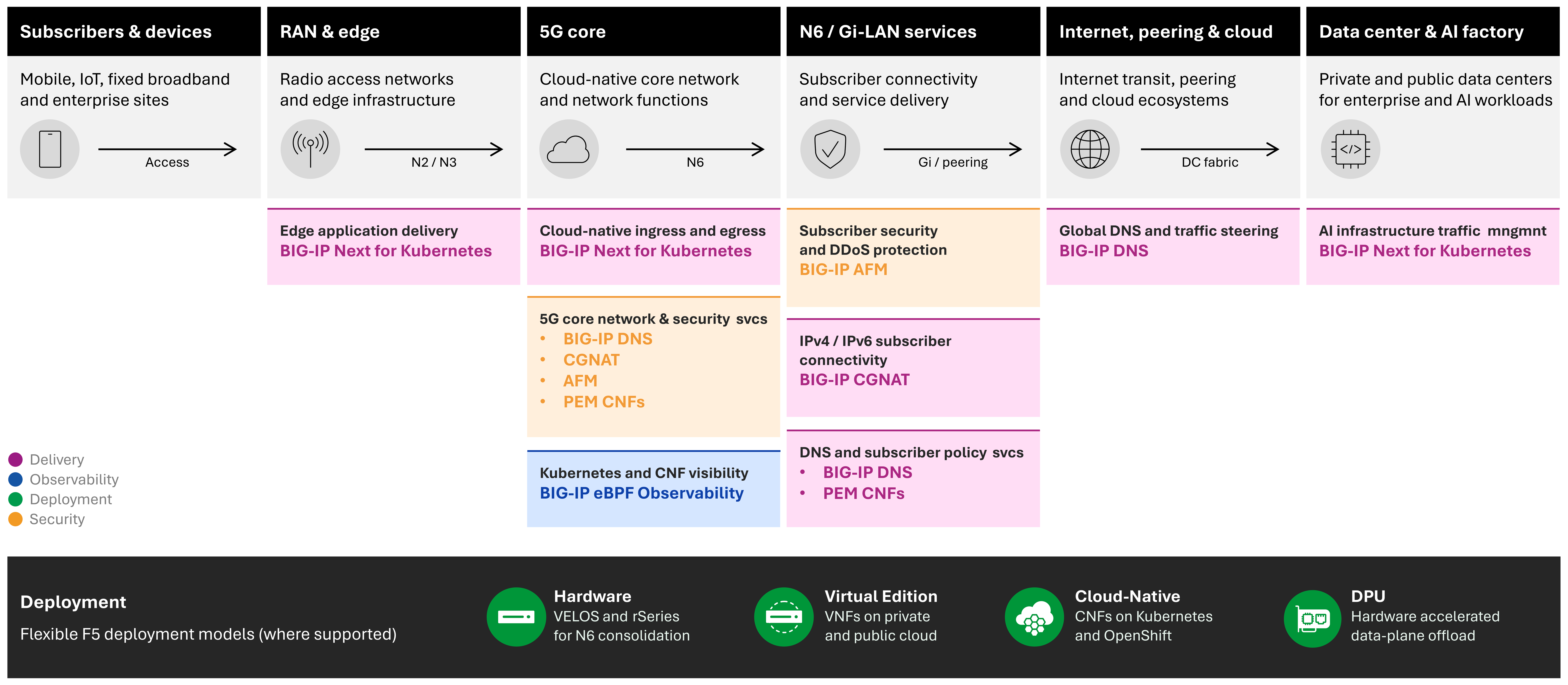
The consolidation story matters as much as any individual function. Service providers can bring these capabilities onto a common cloud-native architecture instead of building, scaling, and operating a separate infrastructure stack around every network function. BIG-IP Cloud-Native Edition also complements existing BIG-IP hardware and virtual deployments, giving operators flexibility in how they modernize.
F5 is also continuing to invest in purpose-built hardware for service provider environments. A next-generation platform planned for later this year is being designed for high-throughput Layer 4 traffic management and subscriber security services, giving operators another option for scaling carrier-grade services as traffic and security demands grow.
The economic impact can be significant. F5 customer analysis has shown that consolidating subscriber services such as firewall, DDoS protection, CGNAT, DNS, and traffic steering can reduce capital costs by more than 60% by lowering CPU and memory requirements and eliminating duplicated infrastructure across separate network functions. The same consolidation can also simplify operations and make it easier to introduce new services as requirements change.
Efficiency changes the economics
At service provider scale, infrastructure efficiency quickly becomes a TCO discussion. CPU and memory requirements affect server count, power, cooling, rack space, and capacity available for additional services.
F5 commissioned The Tolly Group to evaluate two representative F5 BIG-IP Cloud-Native Edition workloads, DNS and Layer 4 plus CGNAT, against a tested VNF deployment in Red Hat OpenShift. The results show why the deployment model matters. In DNS testing, F5 BIG-IP Cloud-Native Edition delivered nearly 1.9 times the query throughput while using 91.5% less CPU. In the Layer 4 plus CGNAT test, F5 BIG-IP Cloud-Native Edition delivered comparable throughput while using 79.7% less CPU and 98.5% less memory.
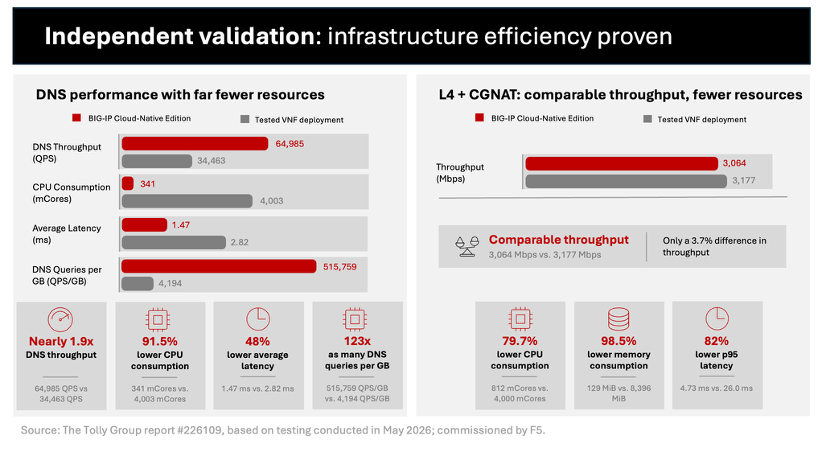
These tests focus on two functions, while the broader value proposition is consolidation across the F5 BIG-IP Cloud-Native Edition offering. Operators can use infrastructure more efficiently while supporting the networking, security, policy, and traffic-management services their environments require.
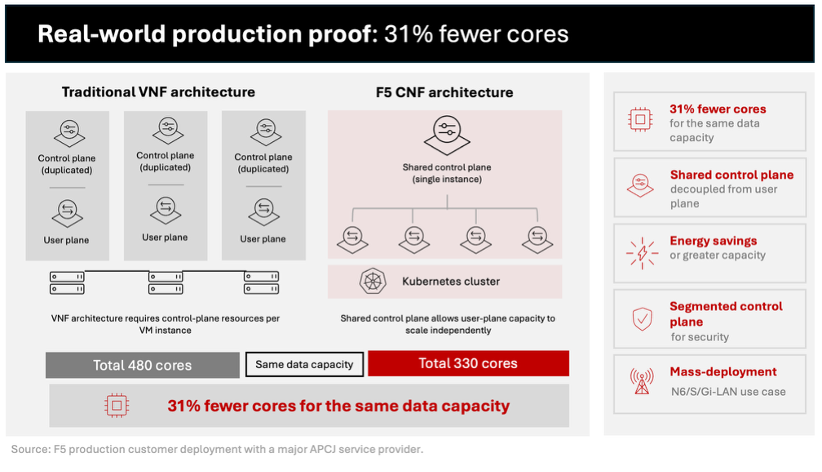
A production customer deployment reinforces that point. In a deployment with a major service provider located in Asia, moving from a VNF-based architecture to F5 cloud-native network functions reduced the compute required for the same data capacity from 480 CPU cores to 330, a 31% reduction. The architecture separates control-plane and user-plane scaling so capacity can be added where traffic required it without duplicating the full stack.
At carrier scale, that difference can translate into fewer servers, lower power requirements, less infrastructure to operate, and more headroom for new services.
From telco cloud to AI grid
The next phase of service provider infrastructure also includes AI. Operators already have an asset that many AI infrastructure providers are still building: a distributed footprint across central data centers, regional facilities, edge sites, and network locations.
An AI grid can connect those resources so workloads are directed toward the location best positioned to serve them based on latency, capacity, cost, location, and policy. That creates an opportunity to turn distributed network infrastructure into a coordinated platform for AI inference, sovereign AI, and GPU-as-a-Service.
F5 can provide traffic-control points across that architecture. Global server load balancing (GSL) functionality from BIG-IP can steer requests across distributed sites based on factors such as availability, performance, and policy, while BIG-IP Next for Kubernetes can manage application and inference traffic within Kubernetes clusters, enforce tenant isolation, and apply traffic policies close to the workload.
For accelerated AI infrastructure, the same F5 BIG-IP Cloud-Native Edition foundation can support Kubernetes environments where high-performance traffic management, tenant isolation, and efficient use of compute resources are increasingly important. This is particularly relevant as service providers build GPU clouds, AI factories, and distributed inference services.
One architecture, less duplication
Kubernetes excels at orchestrating workloads, but traffic control becomes more complex when teams assemble it independently across point tools. At scale, that can fragment the traffic path and create another layer of operational complexity.
The practical benefit of BIG-IP Cloud-native Edition is operational consistency. DNS, CGNAT, firewall, policy enforcement, Kubernetes traffic management, and observability can be planned as parts of a common architecture instead of separate modernization projects.
That matters because each independent stack adds its own lifecycle, resource requirements, security model, telemetry, and operational processes. Consolidating around a common Kubernetes-native foundation gives service providers a way to reduce that overhead, scale individual services according to demand, and introduce new network services without standing up another dedicated infrastructure stack.
Consolidation also gives operators a platform that can evolve with the market.The same cloud-native foundation that supports 5G and N6/SGi-LAN modernization can extend into emerging 6G requirements, distributed edge services, and AI infrastructure. It gives F5 a common platform for continued innovation across network functions, Kubernetes traffic management, observability, and AI as requirements evolve.
That evolution also includes agentic AI. With BIG-IP Next for Kubernetes release 2.4, F5 adds protocol-aware persistence for Model Context Protocol (MCP) sessions and agent-to-agent (A2A) tasks, helping stateful agent interactions stay on the appropriate backend as services scale. OIDC discovery and JWT validation add identity controls at ingress so agent and tool traffic can be validated before reaching backend services.
For service providers building AI platforms and agentic services, that extends the same traffic-control model from traditional applications into stateful, identity-aware agent workloads.
Build for what comes next
Cloud-native modernization is reaching a more practical phase for service providers. The market, technology, and operational readiness are aligning, while AI is raising the stakes for infrastructure efficiency and automation.
BIG-IP Cloud-Native Edition brings BIG-IP networking, security, traffic management, policy enforcement, and observability into that environment through a common Kubernetes-native architecture. Independent testing and production experience show the potential infrastructure-efficiency gains, while maintaining an architecture that can extend into accelerated AI environments.
For service providers, the opportunity is straightforward: simplify the infrastructure supporting today's network services and create room for the services that come next.
Learn more
Explore F5 BIG-IP Cloud-Native Edition to learn how F5 is bringing networking, security, application delivery, and observability into Kubernetes-native environments.
Read The Tolly Group's independent assessment of BIG-IP Cloud-Native Edition to see the infrastructure-efficiency results across DNS and Layer 4 plus CGNAT workloads, and be sure to read today’s press release.
About the Author

Related Blog Posts
Cloud-native modernization for the AI and 5G/6G era
See why 5G/6G, Kubernetes maturity, and AI are accelerating cloud-native modernization, and how F5 BIG-IP Cloud-Native Edition improves efficiency.
Who can you trust in the age of AI agents?
New features for F5 Distributed Cloud Bot Defense enable organizations to distinguish between trusted and fraudulent AI traffic.
Securing F5 NGINX in the age of AI
How F5 is applying AI-driven security practices across the F5 NGINX portfolio to help deliver safer, more resilient software.

From dashboard fatigue to operational excellence: Why XOps needs F5 Insight for ADSP
Learn how F5 Insight for ADSP lays the visibility foundation for XOps—turning fragmented signals across applications and infrastructure into actionable intelligence.
Govern your AI present and anticipate your AI future
Learn from our field CISO, Chuck Herrin, how to prepare for the new challenge of securing AI models and agents.

F5 recognized as one of the Emerging Visionaries in the Emerging Market Quadrant of the 2025 Gartner® Innovation Guide for Generative AI Engineering
We’re excited to share that F5 has been recognized in 2025 Gartner Emerging Market Quadrant(eMQ) for Generative AI Engineering.